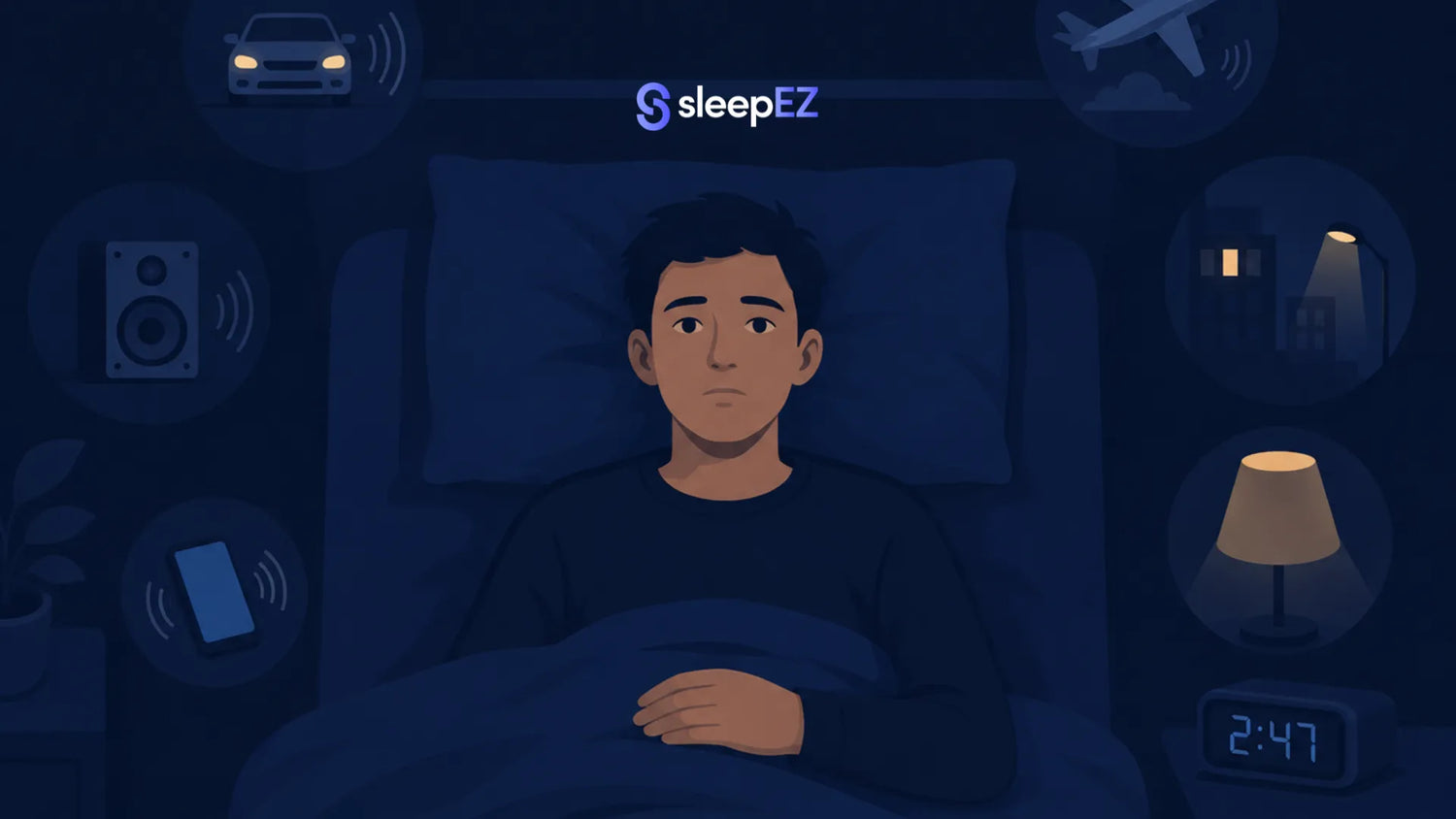
Do you wake up at the slightest sound? Does a passing car's headlights or your partner's movement pull you right out of sleep?
You're not alone, and you're not imagining it.
Being a light sleeper is a real pattern that affects millions of people. It's frustrating to watch others sleep through alarms and thunderstorms while you jolt awake at a door closing down the hall.
This guide explains the science behind why you're a light sleeper and gives you practical steps to get the deep, restorative sleep you need.
Quick Answer: Why Am I a Light Sleeper?
A light sleeper is someone who wakes easily from noise, light, movement, or other small disturbances. Most light sleepers have a lower arousal threshold, meaning their brain remains more alert during sleep.
Common causes include:
- Genetics (fewer sleep spindles, the brain's natural noise-blocking mechanism)
- Stress and anxiety
- Ageing (sleep naturally becomes lighter after 40–60)
- Caffeine and alcohol
- Irregular sleep schedules
- Underlying sleep disorders
Being a light sleeper is not a medical disorder. It's a common experience that can often be improved with the right environment and habits.
Light Sleeper at a Glance
| Question | Answer |
|---|---|
| Is it normal? | Yes, very common |
| Is it a disorder? | Usually no |
| Main causes | Genetics, stress, ageing |
| Biggest triggers | Noise and light |
| Can it improve? | Yes, with the right approach |
| Best solutions | Earplugs, sleep mask, white noise |
| When to see a doctor | If it causes chronic fatigue or daytime impairment |
Why Do I Wake Up From Every Little Noise?
This is one of the most frustrating experiences for light sleepers, and it has a specific biological explanation.
Your brain is more reactive to sudden changes in sound.
It's not the volume of the noise that wakes you, it's the change in sound level. A sudden door closing at 50 dB is more likely to wake you than a steady 60 dB fan running all night.
Sleep spindles are the key.
Sleep spindles are bursts of brain activity that occur during Stage 2 sleep. They act as a protective filter, helping your brain ignore external sounds.
People who naturally produce more sleep spindles are better at sleeping through noise. Light sleepers tend to produce fewer.
Stress amplifies the problem.
When you're anxious or stressed, your nervous system stays in a heightened state of alert, even during sleep. Your brain is essentially scanning for threats, making it more reactive to any sound that occurs.
What helps
White noise or a sound machine creates a consistent background sound that masks sudden noises. When there's no abrupt change in sound level, your brain is less likely to register a disturbance and wake you.
Quick Ways Light Sleepers Can Sleep Better
If you wake up easily during the night, small changes to your sleep environment can make a noticeable difference.
- Block light with blackout curtains or a sleep mask
- Reduce noise using earplugs or white noise
- Keep a consistent sleep and wake schedule
- Use steady background sound to mask sudden noises
- Choose comfortable sleep masks for better darkness and relaxation
- Use soft earplugs designed for overnight comfort
Light sleepers usually benefit most from reducing light and sound disruptions before focusing on more complex sleep strategies.
What Is a "Light Sleeper"?
A light sleeper is someone who wakes up easily from small disturbances. It's not a medical disorder. It's a common experience tied to how sensitive your brain is during sleep.
The technical term is having a low arousal threshold. Your brain stays more alert to outside stimuli like noise, light, or movement.
While someone else might sleep through a dog barking or a car door slamming, these sounds pull you out of sleep.
Common characteristics of light sleepers include:
- Waking up multiple times during the night
- Feeling tired or unrefreshed in the morning
- Being bothered by sounds others don't notice
- Envying people who can "sleep through anything"
- Taking a long time to fall back asleep after waking
Signs You May Be a Light Sleeper
Many light sleepers experience similar patterns during the night. You may be a light sleeper if you regularly notice the following:
- Waking up from small sounds such as doors closing, traffic, or snoring
- Waking up when lights change or sunlight enters the room
- Waking up from movement beside you in bed
- Taking a long time to fall back asleep after waking
- Feeling tired even after spending enough hours in bed
- Feeling more sensitive to your sleep environment than other people
Light sleepers are often more affected by noise, light, stress, and sleep disruptions than heavier sleepers.
What Causes Someone to Be a Light Sleeper?
Several factors determine whether you're a light or heavy sleeper. Some you can't control. Others you can manage.
Genetics and Brain Activity (Sleep Spindles)
Your genes play a significant role. Research shows that people who naturally produce more sleep spindles are better at blocking out noise during sleep.
Sleep spindles are bursts of brain activity that happen during Stage 2 sleep. They act like a protective shield, helping your brain ignore external disturbances.
If you were born with fewer sleep spindles, you're more likely to be a light sleeper. Studies published in Current Biology and other sleep research journals confirm this genetic component.
Lifestyle Factors
Stress and anxiety are major contributors. When you're stressed, your nervous system stays in a heightened state of alert.
Your brain interprets this as a signal to stay vigilant, making you more reactive to sounds and movements during sleep.
People with anxiety often report hypervigilance at night. Their brain won't fully "shut down" because it's scanning for threats, even when there aren't any.
Other lifestyle factors include:
- High caffeine intake, especially in the afternoon
- Irregular sleep schedules
- Alcohol consumption before bed (it fragments sleep)
- Lack of physical activity during the day
Your Age
Sleep naturally becomes lighter and more fragmented as you get older. After age 60, most people spend less time in deep sleep and wake up more frequently during the night.
This is a normal part of aging, though it doesn't make it any less frustrating.
Why Being a Light Sleeper Is So Frustrating
To understand why being a light sleeper affects how you feel, you need to know how sleep works.
Every night, your brain cycles through four stages of sleep:
NREM Stage 1: Light sleep, the transition between waking and sleeping. You can wake up easily.
NREM Stage 2: Slightly deeper sleep. Your heart rate slows, and your body temperature drops. This is where sleep spindles occur.
NREM Stage 3: Deep sleep. This is the most restorative stage. Your body repairs tissue, builds muscle, and strengthens your immune system. It's very hard to wake someone from deep sleep.
REM Sleep: The dream stage. Your brain is active, processing memories and emotions. Your body is essentially paralyzed to keep you from acting out dreams.
You cycle through these stages multiple times each night. A full cycle takes about 90 minutes.
Here's the problem: being a light sleeper means you get interrupted. Every time you wake up, even briefly, you restart the cycle.
These interruptions prevent you from spending enough time in Stage 3 (deep sleep) and REM sleep. Both are critical for feeling refreshed, repairing your body, and consolidating memories.
That's why you can technically sleep for eight hours but still wake up exhausted. The quality of your sleep matters as much as the quantity.
Why Do Some People Sleep Through Anything?
Heavy sleepers aren't just lucky, there's a biological reason they can sleep through alarms and thunderstorms.
Higher sleep spindle production.
Research published in Current Biology found that people who produce more sleep spindles during Stage 2 sleep are significantly better at blocking out noise.
This is largely genetic.
Higher arousal threshold.
Heavy sleepers simply need a stronger stimulus to wake up. Their brains are less reactive to environmental changes during sleep.
Age matters.
Children and young adults tend to sleep more deeply. Deep sleep naturally decreases with age, which is why older adults are often lighter sleepers.
Can you change it?
You can't dramatically change your arousal threshold, but you can reduce the number of stimuli that reach your brain, through earplugs, white noise, blackout curtains, and a consistent sleep environment.
The Best Sleep Environment for Light Sleepers
Light sleepers usually sleep better in a controlled and consistent environment. Small changes to your bedroom can help reduce interruptions and improve sleep quality.
Dark Room
Reducing light helps support melatonin production and deeper sleep. Blackout curtains or a comfortable sleep mask can help block streetlights, headlights, and early morning sunlight.
Cool Room
A cooler room helps support the natural drop in body temperature that happens during sleep. Many people sleep best in a room that feels slightly cool rather than warm.
Sound Control
Reducing sudden noise is one of the most effective ways to improve sleep for light sleepers. Earplugs, white noise, or sound machines can help create a more stable sleep environment.
Breathing Comfort
Breathing disruptions can also interrupt sleep quality. Improving airflow and supporting comfortable breathing may help reduce nighttime waking and improve sleep stability.
Creating a darker, quieter, and more comfortable sleep environment can make a significant difference for people who wake up easily during the night.
How to Become a Deeper Sleeper
You can't change your genetics, but you can significantly reduce the number of times you wake up by controlling your environment and habits.
Reduce Light Exposure
Light is a powerful wake signal. Even small amounts, from streetlights, phone chargers, or early morning sun, can disrupt sleep cycles.
Use blackout curtains and a sleep mask to create complete darkness.
Reduce Noise Exposure
Sudden noises are the most common cause of waking for light sleepers. Two strategies work:
Blocking: Silicone earplugs create a comfortable seal that reduces noise by 25–33 dB. Effective for snoring partners, traffic, and neighbours.
Masking: A white noise machine creates steady background sound that prevents your brain from detecting sudden changes. Many light sleepers find this more comfortable than complete silence.
Keep a Regular Sleep Schedule
Your circadian rhythm thrives on consistency. Going to bed and waking at the same time every day, including weekends, trains your brain to enter deeper sleep stages more reliably.
Lower Stress Before Bed
A 30–60 minute wind-down routine signals your nervous system that it's safe to relax. Try breathing exercises, light stretching, reading, or a guided meditation.
Avoid screens, stressful conversations, and work email.
Avoid Caffeine Late in the Day
Caffeine has a half-life of 5–6 hours. A 3:00 PM coffee is still 50% active at 9:00 PM. Cut off caffeine by early afternoon.
Keep Your Bedroom Cool
The ideal sleep temperature is 15–19°C. A cooler room supports the natural drop in body temperature that happens during deep sleep.
1. Follow Strict Sleep Hygiene
Sleep hygiene means creating consistent habits that support good sleep. For light sleepers, this isn't optional. It's the foundation.
Stick to a schedule: Go to bed and wake up at the same time every day, even on weekends. This trains your internal clock.
Get morning sunlight: Exposure to bright light within 30 minutes of waking helps regulate your circadian rhythm. It tells your brain it's daytime.
Limit caffeine: Caffeine has a half-life of 5-6 hours. If you drink coffee at 3 PM, half of it is still in your system at 9 PM. Cut off caffeine by early afternoon.
Avoid alcohol before bed: While alcohol might make you drowsy, it disrupts your sleep cycles and causes more awakenings during the night.
Exercise regularly: Physical activity improves sleep quality, but avoid intense workouts within 2-3 hours of bedtime.
Keep your bedroom cool: The ideal temperature for sleep is between 15-19°C. A cooler room supports the natural drop in body temperature that happens during sleep.
2. Reduce Stress Before Bed
Your brain needs time to transition from "alert mode" to "sleep mode." A wind-down routine signals that it's time to relax.
Try these techniques 30-60 minutes before bed:
Deep breathing exercises: Slow, controlled breathing activates your parasympathetic nervous system, which calms your body. Try the 4-7-8 technique: breathe in for 4 seconds, hold for 7, exhale for 8.
Progressive muscle relaxation: Tense and release each muscle group, starting from your toes and moving up to your head. This releases physical tension.
Read a physical book: Reading helps your mind shift away from daily stressors. Avoid screens, as blue light suppresses melatonin production.
Meditation or guided imagery: Apps like Calm or Headspace offer sleep-specific meditations that help quiet a racing mind.
Write down your worries: If anxiety keeps you awake, keep a notebook by your bed. Write down what's bothering you. This helps your brain "release" the thoughts instead of ruminating on them.
3. Create a Sleep "Sanctuary" to Block Disturbances
This is the most important strategy for light sleepers. Your goal is to create a protective bubble that shields you from your two main triggers: light and sound.
Solving for Light
Light is a powerful signal to your brain to wake up. Even small amounts of light can disrupt your sleep cycles.
Start with blackout curtains or shades. They block outside light from streetlamps, car headlights, and early morning sun.
For total darkness, an eye mask is a light sleeper's most effective tool. It blocks 100% of light, no matter where you are.
A Bluetooth sleep mask offers an extra benefit: it blocks light while letting you listen to calming audio, white noise, or guided meditation.
This addresses both light sensitivity and the stress reduction step at the same time.
Cover or remove any LED lights in your bedroom. Even the small glow from a phone charger or alarm clock can be enough to disturb sensitive sleepers.
Solving for Noise
Noise is the other main enemy. You have two strategies: blocking the sound or masking it.
Blocking (Silence): If you prefer total quiet, a good pair of silicone earplugs can create a comfortable seal against disruptive noises. They're effective against snoring partners, traffic, or noisy neighbors.
Look for earplugs with a high noise reduction rating (NRR), typically 30-33 decibels.
Masking (Sound): Many people find complete silence unsettling. Your brain strains to listen for sounds in total quiet, which can actually make you more alert.
A better option is to mask unpredictable noises with constant, soothing sound.
A white noise machine is perfect for this. It produces steady sound that covers up sudden noises like a door closing or a dog barking.
These abrupt sounds are what jolt you awake. When they're masked by consistent white noise, your brain doesn't register them as threats.
Sound machine like the Hush+ Light Sound Machine offer multiple sound options that you can choose what works best for you. This is also why many parents use white noise machines for babies. It creates a consistent sound environment that promotes deeper sleep.
Some people prefer a fan for the same reason. It provides both airflow and consistent noise.
The Complete Sanctuary
The most effective approach combines multiple strategies:
- Blackout curtains + eye mask for light
- White noise machine or earplugs for sound
- Cool temperature (60-67°F)
- Comfortable mattress and pillows
- No screens or devices (or use night mode if necessary)
This creates an environment optimized for deep sleep, even if you have a naturally low arousal threshold.
Can You Train Yourself to Sleep More Deeply?
Partially, yes.
You can't directly increase your sleep spindle production or change your arousal threshold. But you can reduce the number of times you wake up by removing the triggers that activate your brain's alert response.
What works:
- Consistent sleep schedule (trains your circadian rhythm)
- Reducing light and noise (fewer triggers = fewer awakenings)
- Stress management (lowers baseline nervous system activation)
- Regular exercise (increases slow-wave deep sleep)
- Limiting alcohol (alcohol fragments sleep cycles despite making you drowsy)
What doesn't work:
- Sleeping longer hours to compensate (quantity doesn't fix quality)
- Forcing yourself to stay in bed after waking (can increase anxiety)
- Napping excessively during the day (reduces sleep pressure at night)
With consistent effort, most light sleepers can meaningfully improve their sleep quality within 2–4 weeks.
Best Sleep Tools for Light Sleepers
Light sleepers are more sensitive to small disruptions during the night. The right sleep tools can help create a darker, quieter, and more stable sleep environment.
Block Light With a Sleep Mask
Even small amounts of light can interrupt sleep cycles and make it harder to stay asleep. Streetlights, early sunlight, and device lights are common problems for light sleepers.
A comfortable sleep mask helps create complete darkness and reduce visual disturbances during the night.
Dreamy Sounds Sleep Mask combines light blocking with slim Bluetooth speakers, allowing you to listen to calming audio, white noise, or meditation tracks while sleeping.
Reduce Noise With Earplugs
Noise is one of the biggest sleep disruptors for light sleepers. Snoring, traffic, neighbours, and sudden sounds can easily interrupt sleep cycles.
Soft silicone earplugs help reduce noise without creating excessive pressure during sleep.
Quietbuds are designed with a flush-fit mouldable silicone shape that supports comfort for side sleepers while helping reduce nighttime noise.
Create Stable Background Sound
Sudden noises are often more disruptive than steady sound. White noise can help mask unpredictable sounds and create a more consistent sleep environment.
A sound machine can help reduce disturbances from snoring, traffic, household noise, or environmental sounds during the night.
Hush sound machines are designed to provide stable background sound options that support deeper and less interrupted sleep for light sleepers.
Is Being a Light Sleeper Bad for Your Health?
Being a light sleeper is not inherently harmful. Many people with a naturally low arousal threshold live perfectly healthy lives.
It only becomes a problem when:
- Chronic fatigue, you're consistently waking multiple times per night and feeling unrefreshed
- Daytime impairment, poor sleep is affecting your work, mood, or relationships
- Insomnia, you're struggling to fall asleep or stay asleep three or more nights per week for three months or longer
If your light sleeping is occasional and manageable, it's simply part of how your brain is wired. If it's causing significant daytime problems, it's worth addressing, either through environmental changes or, if needed, a conversation with your doctor.
When to Talk to Your Doctor
Most light sleepers can improve their sleep with environmental and lifestyle changes. However, you should see a doctor if:
You still feel exhausted after consistently following these strategies for 4-6 weeks.
You suspect sleep apnea: Signs include loud snoring, gasping for air during sleep, morning headaches, or extreme daytime fatigue. Sleep apnea is a serious condition that requires medical treatment.
You have chronic insomnia: If you struggle to fall asleep or stay asleep at least three nights per week for three months or more, you may have chronic insomnia. A sleep specialist can help.
Your sleep problems affect your daily life: If poor sleep is impacting your work, relationships, mood, or safety (like falling asleep while driving), seek professional help.
You have anxiety or depression: These conditions often disrupt sleep. Treating the underlying condition can dramatically improve your sleep quality.
A sleep study (polysomnography) can identify underlying issues like sleep apnea, periodic limb movement disorder, or other sleep disorders that might be contributing to your light sleep.
Conclusion: Take Control of Your Sleep
Being a light sleeper is common and often genetic. It's not a life sentence.
While you can't change your brain's natural sensitivity to disturbances, you can control your environment and habits.
By managing the triggers that wake you up (light and sound) and adopting practices that promote deeper sleep (stress reduction and sleep hygiene), you can significantly improve your sleep quality.
You don't need to do everything at once. Start by tackling your biggest trigger, whether it's light or noise, tonight. Then build from there.
Better sleep is possible. It just requires the right approach for your sensitive brain.
Start tonight: Identify your main sleep disruptor and address it with one of the strategies above. Your body will thank you tomorrow.
Frequently Asked Questions
Why am I such a light sleeper?
Light sleeping is largely genetic. People who naturally produce fewer sleep spindles, bursts of brain activity during Stage 2 sleep, are more reactive to noise and other disturbances.
Stress, anxiety, ageing, and lifestyle factors can make it worse.
Is being a light sleeper genetic?
Yes, significantly. Research shows that sleep spindle production, the brain's main mechanism for blocking out noise during sleep, is strongly influenced by genetics.
How do I become a deeper sleeper?
Focus on your sleep environment first: blackout curtains or a sleep mask for light, earplugs or white noise for sound. Then address lifestyle factors: consistent sleep schedule, stress management, limiting caffeine, and regular exercise.
Why do I wake up from every noise?
Light sleepers are more sensitive to sudden changes in sound level. Your brain's arousal threshold is lower, meaning it reacts to smaller stimuli.
White noise helps by eliminating the sudden changes in sound that trigger waking.
Do light sleepers get less deep sleep?
Often, yes. Frequent awakenings interrupt sleep cycles and reduce time spent in Stage 3 (deep sleep) and REM sleep.
This is why light sleepers can spend 8 hours in bed but still wake up feeling unrefreshed.
Is it normal to wake up easily?
Yes. Being a light sleeper is very common and is not a medical disorder.
It becomes a concern only when it causes chronic fatigue or significantly affects daily functioning.
Can earplugs help light sleepers?
Yes. Silicone earplugs reduce noise by 25–33 dB, which can significantly reduce nighttime awakenings from snoring, traffic, and household sounds.
Many light sleepers find them one of the most effective tools available.
Does white noise help light sleepers?
Yes. White noise creates a steady background sound that masks sudden noises, the type most likely to wake a light sleeper.
It prevents your brain from detecting abrupt changes in sound level.
Can a sleep mask help light sleepers?
Yes. Even small amounts of light can disrupt sleep cycles.
A sleep mask blocks 100% of light from streetlamps, early sunlight, and indoor sources, reducing a major trigger for light sleepers.
Why do I wake up so easily?
Light sleepers tend to have a lower arousal threshold, which means their brain reacts more easily to sounds, light, movement, or other disturbances during sleep.
Is being a light sleeper bad?
Being a light sleeper is not usually a medical problem, but frequent sleep interruptions can reduce sleep quality and leave you feeling tired or unrefreshed.
Can anxiety make you a light sleeper?
Yes. Stress and anxiety can keep your nervous system more alert during sleep, making you more sensitive to noise and other disturbances at night.
Do earplugs help light sleepers?
Earplugs can help reduce noise disruptions from snoring, traffic, neighbours, or household sounds. Many light sleepers use soft silicone earplugs to improve sleep quality.
Can white noise help light sleepers?
Yes. White noise creates a steady background sound that helps mask sudden noises that might otherwise wake you up during the night.
Why do noises wake me up at night?
Light sleepers are often more sensitive to sudden changes in sound. Unexpected noises can interrupt sleep cycles and trigger brief awakenings, even if the sound is not very loud.
Can sleep masks help light sleepers?
Sleep masks can help reduce light disturbances from streetlights, early sunlight, or indoor lighting. Blocking light may help support deeper and less interrupted sleep.

Leave a comment
This site is protected by hCaptcha and the hCaptcha Privacy Policy and Terms of Service apply.