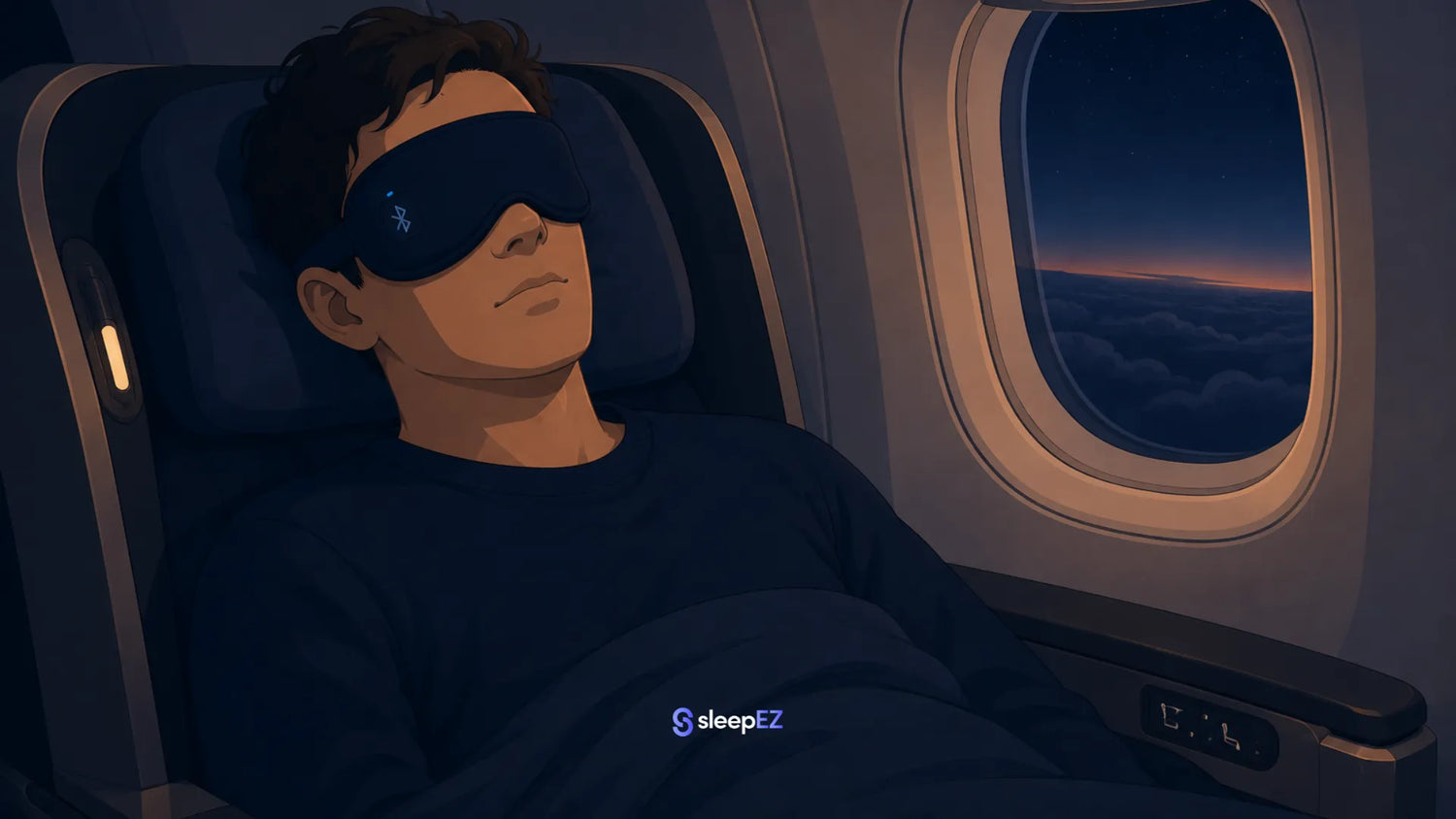
When flying from Australia across multiple time zones, a high-quality sleep mask can be your best defense against jet lag.
By creating instant darkness, it helps regulate melatonin and signals your body when to sleep. This aids smoother adjustment to your new destination's time.
Quick Answer: Does a Sleep Mask Help with Jet Lag?
Yes, a sleep mask helps with jet lag by blocking light at the times your body needs darkness to adjust its circadian rhythm. Light is the primary signal your brain uses to set its internal clock.
Controlling when you're exposed to light (and when you block it) is the core of evidence-based jet lag management.
A sleep mask is most useful: on the flight itself (to sleep when it's nighttime at your destination), on arrival (to block morning light if you need to sleep during the day), and during the first 2–3 days of adjustment.
Why Light Is the Enemy of Jet Lag Recovery
Jet lag happens because your circadian rhythm, your body's internal 24-hour clock, is set to your home time zone. When you cross multiple time zones, your clock is out of sync with local day and night.
Light is the most powerful tool for resetting that clock. Your eyes contain specialised cells (intrinsically photosensitive retinal ganglion cells) that detect light and send signals directly to the suprachiasmatic nucleus, your brain's master clock.
Bright light at the wrong time reinforces your old time zone; bright light at the right time accelerates adjustment to the new one.
The practical rule: At your destination, seek light when it's daytime there, and block it when it's nighttime there, even if your body is telling you the opposite.
A sleep mask is the simplest, most portable tool for the "block it" half of that equation. It creates complete darkness on demand, regardless of whether you're on a plane with cabin lights on, in a hotel room with thin curtains, or trying to sleep at 2pm local time after an overnight flight.
The Jet Lag Challenge: Departing from Down Under
Long-haul flights from Australia often mean crossing many time zones. This creates unique challenges that make jet lag worse than shorter trips.
Understanding Your Body's Clock
Your body runs on a 24-hour internal clock called your circadian rhythm. Light controls this clock. When you see bright light, your brain stays alert.
In darkness, it produces melatonin to make you sleepy.
Flying across time zones throws this system off balance. Your body thinks it's one time while the clock says something else. The bigger the time difference, the worse you feel.
East vs. West Travel
Flying east from Australia hits you harder than going west. When you fly to North or South America, you "lose" hours from your day. Your body struggles to catch up.
Flying west to Europe or Asia adds hours to your day. This feels more natural since it's easier to stay up late than wake up early.
Many popular destinations from Australia require eastward travel. This means Australian travelers often face the toughest form of jet lag.
Common Jet Lag Symptoms
Jet lag hits Australian travelers with a range of disruptive symptoms that can ruin the first few days of any trip:
- Extreme tiredness during the day when you should feel alert
- Wide awake at 3 AM when your body craves sleep
- Stomach problems and loss of appetite at meal times
- Feeling cranky, moody, or easily frustrated
- Brain fog that makes simple decisions feel difficult
- Poor focus and memory problems
Australian business travelers frequently report that the Sydney to Los Angeles route creates the worst jet lag of any destination.
The 15-hour time difference leaves many people feeling completely backwards for days.
Travelers on the Melbourne to Vancouver route often describe feeling like "zombies" for their first business meetings.
These symptoms last longer on flights from Australia due to the massive distances traveled.
While a short European trip might cause 2-3 days of jet lag, Australian flights can leave you feeling off for a full week.
What to Look for in a Jet Lag / Travel Sleep Mask
Not all sleep masks are equal for travel. Based on criteria used by leading jet lag experts and travel sleep specialists, here's what matters:
1. True blackout at the nose bridge.
This is where most masks fail. Light enters around the nose even when the mask fits well elsewhere. Look for a contoured design with a fitted nose bridge that seals against your face.
2. No contact with the eyes.
Flat fabric masks press against the eyelids, which is uncomfortable on a 14-hour flight and may restrict eye movement during REM sleep. Contoured or cupped designs allow eyes to move freely.
3. Stays in place when you move.
You'll shift position on a flight. An adjustable, non-slip strap is essential, a mask that slips off at 3am is useless.
4. Breathable for long wear.
You may wear this for 8–14 hours. Lightweight, breathable fabric prevents overheating and discomfort.
5. Built-in audio (optional but valuable for long-haul).
Flights are loud, engine noise, cabin announcements, other passengers. A mask with built-in Bluetooth speakers lets you stream white noise or sleep audio to mask cabin noise without earbuds pressing against your ears.
This is where the Dreamy Sounds mask adds genuine value over a basic blackout mask.
Sleep Mask vs Basic Eye Mask vs Audio Sleep Mask
| Feature | Basic Eye Mask | Travel Sleep Mask | Audio Sleep Mask (Dreamy Sounds) |
|---|---|---|---|
| Blocks light | ⚠️ Partial | ✅ 100% blackout | ✅ 100% blackout |
| Nose bridge seal | ❌ Usually poor | ✅ Contoured | ✅ Contoured |
| Eye cup design | ❌ Flat fabric | ✅ Usually contoured | ✅ Contoured |
| Side-sleeper comfort | ⚠️ Variable | ✅ Good | ✅ 4mm ultra-thin speakers |
| Built-in audio | ❌ No | ❌ No | ✅ Bluetooth streaming |
| Masks cabin noise | ❌ No | ❌ No | ✅ Via white noise/audio |
| Travel portability | ✅ Very compact | ✅ Compact | ✅ Compact |
| Price | Low | Moderate | Higher |
For short flights or budget travel: A good basic travel mask (Manta, Nidra) does the job. For long-haul flights from Australia (14+ hours): The audio layer becomes genuinely useful, engine noise is a significant sleep disruptor, and the Dreamy Sounds mask addresses both light and noise in one product.
A Sleep Mask: Your Personal Time Zone Aligner
A high-quality sleep mask gives you control over light exposure. This control is key to beating jet lag on long flights.
Instant Darkness for Melatonin Release
Total darkness sends the strongest signal to your brain to make melatonin. This hormone makes you sleepy and helps reset your internal clock.
On planes, cabin lights stay on during "day" hours at your starting point. But it might be bedtime where you're going.
A sleep mask creates darkness when you need it most. Travelers on 14-hour flights to North America report getting 4-5 hours of quality sleep when using a good mask, compared to just 1-2 hours without one.
Hotel rooms in new cities often have bright street lights or thin curtains.
Many Australian travelers discover that European hotel rooms have especially poor light blocking.
Your mask becomes essential for sleeping past 5 AM in cities like London or Amsterdam.
Noise Isolation (and Soothing Sounds)
Good sleep masks muffle airplane noise, crying babies, and chatty passengers. Some masks include built-in headphones for even better sound control.
You can play white noise, calm music, or sleep stories. This drowns out disruptions and creates a peaceful sleep space.
Frequent flyers on the Perth to London route often use rain sounds or ocean waves to mask the constant engine noise on those 17-hour Qantas flights.
The combination of darkness and controlled sound helps travelers fall asleep 30-40 minutes faster than masks alone.
Establishing a Sleep Cue
Your brain learns patterns. When you put on your sleep mask consistently, your mind recognizes it's time to wind down.
This works like a bedtime routine.
The mask becomes a trigger that tells your body to start getting sleepy. Over time, just putting it on makes you feel drowsy.
Enhanced Comfort for Long Hauls
Ultra-soft materials and zero-pressure designs make 14+ hour flights bearable. Cheap masks dig into your face or slip off during sleep.
Quality masks use memory foam and silk-like fabrics. They stay put without pressure points. This comfort lets you actually sleep instead of just resting your eyes.
Australia's Toughest Routes: Light Strategy by Flight
The specific challenge varies by route. Here's how to think about light management on Australia's most common long-haul flights.
Sydney/Melbourne → London (via Dubai or Singapore, ~24 hours)
This is one of the most demanding routes. You're crossing 9–10 time zones eastward, the harder direction.
On the first leg, use your mask to sleep during the flight's "nighttime" relative to London. On arrival, seek morning light and use your mask to block afternoon light if you need to rest.
Sydney/Melbourne → Los Angeles (~15 hours, westward)
Westward travel is generally easier. The flight typically departs in the evening and arrives in the morning LA time. Use your mask to sleep through the flight and arrive as rested as possible.
Perth → London (direct, ~17 hours)
One of the world's longest non-stop routes. Light management is critical, use your mask aggressively to sleep during the London nighttime window regardless of what the cabin lights are doing.
Note: The specific light-timing strategy depends on your exact departure and arrival times. Apps like Timeshifter provide personalised light/dark schedules based on your specific flight.
Packing for the Journey: The Traveller's Sleep Kit
A sleep mask addresses light. But flights have another major sleep disruptor: noise.
Engine noise on a long-haul flight runs at approximately 80–85 dB, well above the level that disrupts sleep. Cabin announcements, other passengers, and galley noise add to this.
The complete travel sleep kit:
- Sleep mask, blocks light on demand (Dreamy Sounds for audio + blackout; basic travel mask for budget)
- Earplugs, QuietBuds silicone earplugs reduce noise by 25–33 dB with a comfortable, side-sleeper-friendly fit that works in an aircraft seat
- Neck pillow, supports head position in an upright seat
If you're using the Dreamy Sounds mask, you can stream white noise through the built-in speakers to mask cabin noise, which may reduce or eliminate the need for separate earplugs depending on your noise sensitivity.
Your Travel Companion: Sleepez
The right sleep mask transforms your travel experience. It provides 100% light blackout essential for resetting your internal clock. Quality masks offer noise dampening and soothing audio for peace during noisy flights.
Superior comfort and portability make those long-haul flights from Australia more manageable. Instead of arriving exhausted, you can start your trip refreshed.
Don't let jet lag dictate the start of your adventure. Equip yourself with a sleep mask designed for superior comfort and effective sleep support. The Sleepez Dreamy Sounds Sleep Mask ensures a smoother transition on your next international flight from Australia.
Frequently Asked Questions
Does a sleep mask help with jet lag?
Yes, by blocking light at the right times, a sleep mask helps your circadian rhythm adjust to the new time zone. Light is the primary signal your brain uses to set its internal clock, so controlling light exposure is the core of evidence-based jet lag management.
What is the best sleep mask for long-haul flights?
Look for true blackout at the nose bridge, a contoured eye-cup design, an adjustable non-slip strap, and breathable fabric. For long-haul flights (14+ hours), a mask with built-in audio to mask cabin noise adds significant value.
How do I use a sleep mask on a plane?
Put it on when you want to sleep, aligned with nighttime at your destination. Use it to block cabin lights, window light, and screen glare from other passengers.
Combine with earplugs or audio for maximum sleep quality.
Is jet lag worse flying east or west?
Eastward travel is generally harder. Flying east requires advancing your clock (going to bed earlier), which is biologically more difficult than delaying it.
The Sydney–London route (eastward, 9–10 time zones) is one of the most demanding.
How long does jet lag last?
A general rule is approximately one day of adjustment per time zone crossed, though individual variation is significant. Eastward jet lag typically lasts longer than westward.
Can a sleep mask replace melatonin for jet lag?
They address different mechanisms. Melatonin supplements help shift your circadian timing; a sleep mask controls light exposure, which is the primary environmental cue for circadian adjustment.
Many travellers use both as complementary tools.

Leave a comment
This site is protected by hCaptcha and the hCaptcha Privacy Policy and Terms of Service apply.