
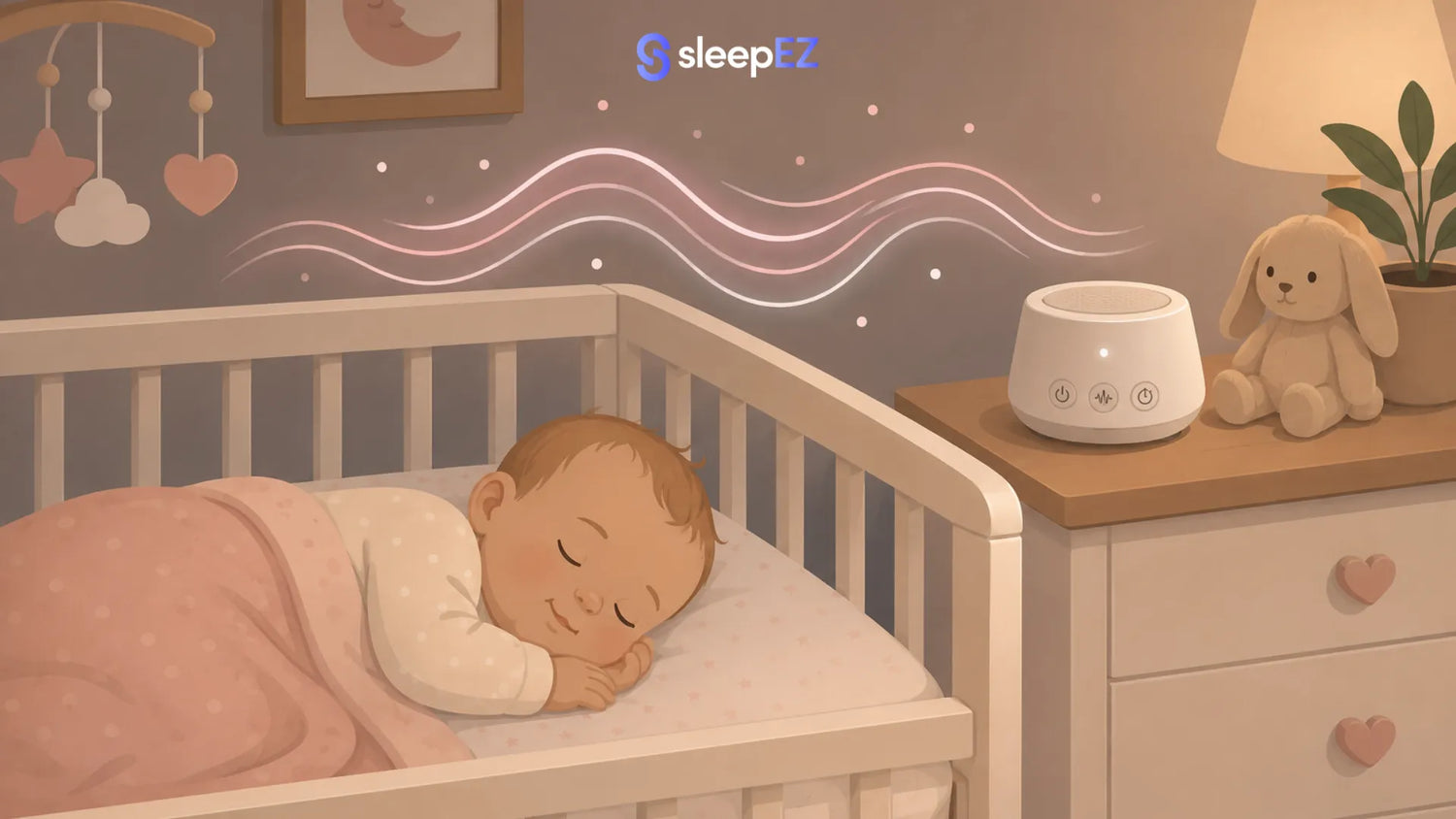
You've heard that a sound machine can help your baby sleep. Great. But now you're staring at product pages that mention white noise, pink noise, and brown noise.
What's the difference? Which one actually works?
This guide explains the difference simply and helps you decide which sound is best for your nursery.
Quick Answer: White Noise or Pink Noise for Babies?
For most babies, pink noise is slightly preferred because it sounds softer and more natural, similar to steady rain or wind, and may encourage deeper sleep. White noise is better at masking loud household sounds due to its higher-frequency energy.
Both are safe when used below 50 dB at crib level and placed at least 2 metres from the crib.
The practical answer: Try both and see which your baby responds to better. Many sound machines offer both options.
What Are the "Colors" of Noise? (A Simple Guide)
The "colors" of noise describe how sound energy is distributed across different frequencies. Think of it like the difference between bass and treble on a speaker. Each color has a different mix.
What is White Noise?
White noise sounds like a hissing radiator, an untuned radio, or a vacuum cleaner.
It has equal power across all sound frequencies, from low rumbles to high pitches. This makes it sound sharp or "hissy" to most ears.
What Is Pink Noise for Babies?
Pink noise is a type of background sound with more energy in lower frequencies than white noise, giving it a deeper, softer quality. For babies, it sounds like:
- Steady rainfall
- Wind through trees
- Rustling leaves
- A gentle waterfall
Why pink noise works for babies:
- Its softer, lower-frequency profile is gentler on developing hearing
- It more closely resembles the sounds of the womb environment
- Many babies find it more soothing than the sharper quality of white noise
- It may support deeper sleep by creating a consistent, calming background
Which Noise Is Better for Different Sleep Problems?
| Situation | Better Choice |
|---|---|
| Noisy apartment or street | White Noise (better masking) |
| Light sleeper baby | Pink Noise (supports deeper sleep) |
| Sleep regressions | Pink Noise |
| Siblings or household noise | White Noise |
| Travel and unfamiliar environments | White Noise |
| Newborn settling | Pink Noise (womb-like) |
| General overnight use | Either, personal preference |
Is Pink Noise Safe for Babies?
Yes, pink noise is safe for babies when used correctly.
Safety guidelines:
- Keep volume below 50 dB at crib level (use a free decibel app to check)
- Place the sound machine at least 2 metres from the crib
- Use continuous play avoid sounds with variable volume
- Do not place the machine inside the crib or directly beside the baby's head
Pink noise is often preferred for babies over white noise because its softer, lower-frequency profile is gentler on developing hearing. See our full safety guide: How Loud Is Too Loud for a Baby Sound Machine?
Pink Noise vs Brown Noise for Babies
| Pink Noise | Brown Noise | |
|---|---|---|
| Sounds like | Rain, wind | Deep rumble, distant thunder |
| Frequency | More low-frequency than white | Even more low-frequency than pink |
| Baby-friendliness | ✅ Well-studied | ⚠️ Less research in infants |
| Soothing quality | High | Very high |
| Recommendation | ✅ Commonly recommended | ⚠️ Try if pink doesn't work |
Brown noise is deeper and more rumbling than pink noise. Some babies respond well to it, particularly those who find white noise too sharp.
However, pink noise has more research support for infant sleep.
What's Best for Your Baby's Sleep?
Both sounds can help babies sleep, but they work differently.
The Case for White Noise
White noise covers all frequencies equally. This makes it excellent at masking sudden, external noises like a dog barking, a door slamming, or a truck passing by.
It creates a consistent wall of sound that drowns out disruptions.
If you live in a noisy home or apartment, white noise does its job well.
The Case for Pink Noise
Pink noise has advantages that matter for infant sleep.
It's more balanced.
The sharp hiss of white noise can be irritating over time. Pink noise has a softer, deeper quality that sounds more like the rhythmic shushing babies heard in the womb.
It promotes deeper sleep.
Studies have shown that pink noise may help increase slow-wave sleep, the deepest and most restorative stage of sleep. This matters for babies who need quality rest to grow and develop.
The verdict: White noise is great for masking disruptive sounds. But for soothing a baby and promoting deep, restful sleep, pink noise is often the better choice.
What Sound Do Newborns Prefer?
Newborns are accustomed to the sounds of the womb, approximately 50 dB of continuous sound including blood flow, digestion, and the mother's heartbeat.
What works best for newborns:
- Pink noise, most closely resembles womb sounds in quality
- Shushing sounds, mimic the "shhh" parents instinctively make
- White noise, effective for masking household sounds
- Heartbeat sounds, some newborns respond well initially
What to avoid for newborns:
- Music with variable volume or melody
- Sounds above 50 dB at crib level
- Sounds placed inside the crib or directly beside the baby's head
How to Use a Sound Machine Safely for Your Baby
Safety comes first. The American Academy of Pediatrics (AAP) supports using sound machines if you follow these rules:
Keep the volume low.
Keep it below 50 decibels, about the sound of a quiet dishwasher. Loud sound machines can damage your baby's hearing.
Keep it at a distance.
Place the machine across the room from the crib, not right next to your baby's head. Distance reduces sound intensity naturally.
Don't run it 24/7.
Use it during sleep periods (naps and nighttime) to help signal that it's time to rest. Turn it off when your baby is awake and playing so they can hear normal household sounds and develop language skills.
Read: White Noise Machine Baby
Choosing a Sound Machine That Offers Both White and Pink Noise
The easiest way to find which sound works best for your baby is to use a sound machine that offers multiple options.
What to look for:
- White noise, pink noise, and brown noise options
- Adjustable volume with clear increments
- Continuous play mode
- Compact design suitable for nursery use
The Hush Sound Machine offers multiple sound options including white and pink noise, adjustable volume, and a compact design. This makes it easy to test different sounds and find what works best for your baby, without needing multiple devices.
Our Recommendation: A Machine That Gives You Options
Here's the problem: some babies prefer the masking power of white noise, while others respond better to the depth of pink noise. You don't want to buy a machine and discover it has the wrong sound.
This is why a machine with multiple sound options is the smartest investment.
The Hush Light Sound Machine, for example, includes white noise, pink noise, and brown noise so you can find the exact tone that works best for your baby (or even for you). For a dedicated nursery option, the White Noise Machine Baby also provides these soothing sounds.
Frequently Asked Questions
Is pink noise better than white noise for babies?
For most babies, pink noise is slightly preferred because it sounds softer and more natural. White noise is better at masking very loud household sounds.
Both are safe when used correctly.
Can babies sleep with pink noise all night?
Yes, at safe volumes (below 50 dB at crib level) and proper distance (2+ metres). Continuous overnight use is safe and can help babies link sleep cycles.
What volume should pink noise be for babies?
Below 50 dB at crib level. Use a free decibel meter app to check. Place your phone at mattress level, not next to the machine, for an accurate reading.
Is brown noise safe for babies?
Brown noise is generally considered safe at appropriate volumes. However, it has less research support for infant sleep than white or pink noise.
Try it if other sounds don't work.
What is the best sound for newborn sleep?
Pink noise is often recommended for newborns because it most closely resembles womb sounds. White noise is also effective for masking household disturbances.
Can babies become dependent on white noise?
All babies develop sleep associations, white noise is simply one of them. It's not inherently more problematic than other associations, and it has the advantage of being consistent and controllable.
When should I stop using white noise for my baby?
There's no set age. See our full guide: When Should You Stop Using White Noise for Your Baby?
Conclusion: Find the Right Sound for Your Family
The "best" sound is the one your baby sleeps best with. Pink noise is a solid, evidence-backed place to start because of its soothing qualities and deep-sleep benefits.
By choosing a machine with multiple options, you'll be ready for anything. Test different sounds, watch how your baby responds, and adjust as needed.
That's what good parenting looks like.

Leave a comment
This site is protected by hCaptcha and the hCaptcha Privacy Policy and Terms of Service apply.