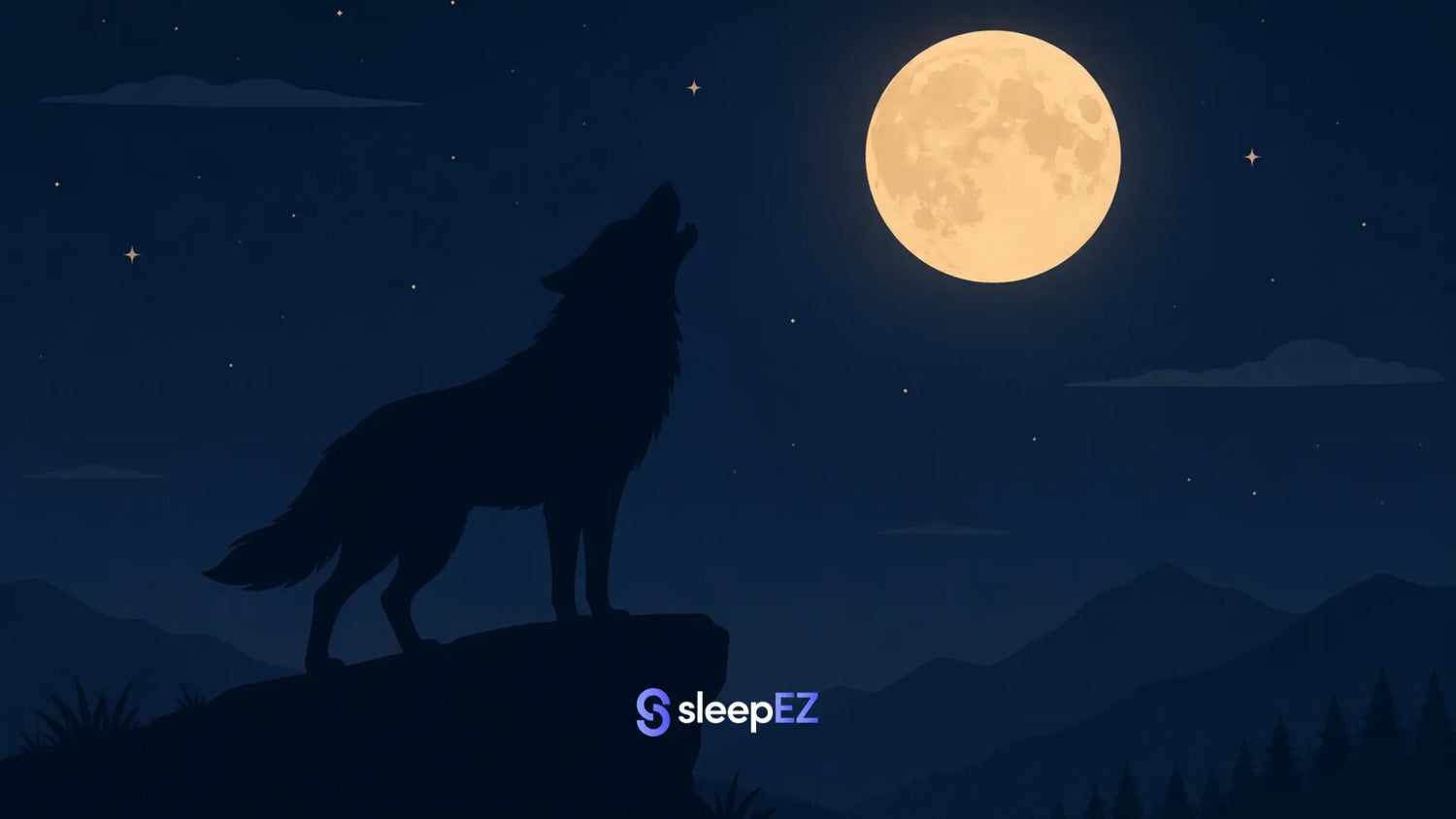
If you feel like your day is just beginning when everyone else's is ending, you're not lazy. You're a Wolf chronotype.
Welcome to the club of creative, late-night thinkers. This guide isn't just about understanding your Wolf chronotype.
It's about learning to thrive because of it.
If you're just starting your journey, you can discover your chronotype and learn about the other types in our main Guide to Sleep Chronotypes.
Quick Answer: What Is the Wolf Chronotype?
The Wolf Chronotype is the night owl sleep type, naturally waking later and feeling most alert and productive in the evening. Wolves represent approximately 15–20% of the population.
Key Wolf traits:
- Wake time: 8:30–9:00 AM (or later if possible)
- Bedtime: 12:00–1:00 AM
- Peak productivity: Late afternoon to evening (5:00–9:00 PM)
- Biggest challenge: Morning obligations that conflict with their natural schedule
- Population: ~15–20%
Wolf Chronotype at a Glance
| Trait | Wolf Chronotype |
|---|---|
| Wake Time | 8:30–9:00 AM (or later) |
| Bedtime | 12:00–1:00 AM |
| Peak Productivity | 5:00–9:00 PM |
| Best Exercise Time | Late afternoon or early evening |
| Personality | Creative, independent, impulsive, risk-taking |
| Biggest Challenge | Morning obligations, social jet lag |
| Population | ~15–20% |
| Best Matched With | Wolf, Bear |
What is a Wolf Chronotype? The Core Traits of a True Night Owl
The Wolf chronotype represents approximately 15% of the population who are naturally wired to sleep late and wake up late. Your internal body clock runs about 2-3 hours behind the average person's schedule.
As a Wolf, your brain doesn't start producing melatonin (the sleep hormone) until around midnight or later. This means you naturally feel most alert and creative between 5 PM and midnight.
Research on chronotypes shows these differences are biologically based, not personal failings. You probably recognize yourself in these traits:
Your Core Personality Traits:
- Highly creative and innovative - You think outside the box naturally
- Independent and self-reliant - You work best without micromanagement
- Open to new experiences - You embrace change and novelty
- Intuitive decision-making - You trust your gut instincts
- Flexible and adaptable - You handle unexpected changes well
- Emotionally expressive - You connect deeply with others
- Risk-taking nature - You're willing to try unconventional approaches
- Spontaneous - You thrive on last-minute plans and adventures
- Deep thinker - You process information thoroughly before acting
- Artistic sensibilities - You appreciate beauty and creative expression
Your Natural Strengths:
- Peak cognitive performance in evening hours (5 PM - midnight)
- Superior creative thinking and problem-solving at night
- High productivity during quiet, distraction-free hours
- Strong emotional intelligence and empathy
- Ability to work independently for long periods
Your Common Challenges:
- Severe difficulty with early morning schedules
- Social jet lag from mismatched world schedules
- Afternoon energy crashes before evening peak
- Sleep deprivation from forced early wake times
- Feeling misunderstood or judged for sleep preferences
Scientific studies show that Wolves have a natural three-hour delay in their circadian rhythm compared to Lions. This isn't laziness - it's your biology working on a different schedule.
Wolf Chronotype Schedule: The Ideal Daily Routine
| Time | Activity |
|---|---|
| 8:30–9:00 AM | Wake, don't rush; allow 30 minutes to come online |
| 9:30 AM | Light breakfast |
| 10:00 AM–12:00 PM | Admin, email, routine tasks (brain still warming up) |
| 12:00 PM | Lunch |
| 1:00–3:00 PM | Meetings, collaborative work |
| 3:00–5:00 PM | Creative work beginning to peak |
| 5:00–9:00 PM | Deep work, peak cognitive and creative window |
| 7:00 PM | Dinner |
| 9:00–10:00 PM | Exercise (if not done earlier) |
| 11:00 PM | Begin wind-down |
| 12:00–1:00 AM | Sleep |
Key challenge: Most conventional work schedules conflict directly with the Wolf's natural productivity window. Wolves who can shift their schedule, or work in roles with flexible hours, perform significantly better.
How Do I Know If I'm a Wolf Chronotype?
You may be a Wolf if you consistently experience the following:
- ✅ You feel most creative and productive in the evening
- ✅ You struggle to fall asleep before midnight, even when tired
- ✅ Morning alarms feel brutal, you're rarely ready to wake before 8:30 AM
- ✅ You feel most alert after 5:00 PM
- ✅ You do your best thinking late at night
- ✅ You struggle with early morning meetings or obligations
- ✅ You feel like a different person in the evening compared to the morning
- ✅ Weekends feel better because you can sleep on your natural schedule
Wolf Chronotype Weaknesses
Wolves have significant strengths, but their chronotype also creates real challenges in a world built around conventional schedules.
Social jet lag. Most work, school, and social schedules are built around Bear and Lion timing. Wolves are perpetually fighting their biology to meet morning obligations, accumulating sleep debt and performing below their potential.
Morning impairment. Wolves genuinely function poorly in the morning. This isn't laziness, their cortisol peak, body temperature, and cognitive performance all lag several hours behind other chronotypes.
Relationship challenges. Wolves paired with Lions or early Bears face significant schedule incompatibility, different bedtimes, different morning energy, different social preferences.
Health risks of chronic misalignment. Wolves who are forced into conventional schedules long-term may face higher risks of metabolic disruption, mood disturbances, and chronic fatigue compared to chronotypes whose schedules align with social norms.
The Science Behind Your Wolf Energy
Your circadian rhythm operates on a delayed phase compared to other chronotypes. Your cortisol levels peak later in the morning, which is why you feel groggy for hours after waking.
Your melatonin production starts much later - often not until midnight or 1 AM - keeping you naturally alert when others are winding down.
Your core body temperature stays elevated longer into the evening, maintaining your energy and alertness. This temperature pattern drives your late-night productivity and explains why you feel most creative when the world grows quiet.
The #1 Challenge for Wolves: Understanding Social Jet Lag
Social Jet Lag is the scientific term for what you experience every day. It's the mismatch between your internal body clock and the demands of a 9-to-5 world.
This is why you feel groggy and "jet-lagged" on Monday mornings, even when you've slept enough hours. Your body is literally fighting against its natural rhythm to meet society's schedule.
Research shows that this chronic misalignment affects your health, mood, and performance. The good news?
Understanding this gives you power to work with your biology instead of against it.
The Wolf's Daily Blueprint: An Ideal Schedule for Peak Performance
This isn't just a schedule. It's your blueprint for peak performance as a Wolf chronotype.
7:30 AM - 9:00 AM: Gentle Wake-Up & Sunlight Exposure
Skip jarring alarms. Get 15 minutes of direct sunlight to signal your brain to start the day.
The National Institute of General Medical Sciences explains this light exposure is critical for regulating your internal clock.
9:00 AM - 10:00 AM: Light Movement & Delayed Breakfast
Take a short walk or do some stretching. You're probably not hungry yet, so eat a light, late breakfast. Wait at least 90 minutes after waking before having caffeine.
10:00 AM - 1:00 PM: Administrative & Creative Prep Work
Your energy is still ramping up. Handle emails, planning, and less demanding creative tasks. Save the heavy lifting for later.
1:00 PM - 2:00 PM: Lunch & A Midday Walk
Eat a solid lunch to fuel your coming energy peak. Take a short walk outside to aid digestion and boost alertness.
2:00 PM - 5:00 PM: Collaborative Work & Social Engagement
Your energy and sociability are rising. Schedule meetings, brainstorming sessions, and collaborative projects during this window.
5:00 PM - 9:00 PM: Peak Productivity Window (The "Deep Work Cave")
This is your golden time. Your brain reaches maximum capacity for:
- Complex problem-solving and analysis
- Creative work requiring deep concentration
- Writing, coding, designing, or composing
- Strategic planning and big-picture thinking
- Important decisions requiring careful thought
Block this time completely. Turn off notifications, close your door, and create your perfect work environment.
9:00 PM - 10:30 PM: Wind Down & Personal Pursuits
Transition from focused work to personal creative hobbies, reading, or light social time with other night owls.
10:30 PM - 12:00 AM: Disconnect & Prepare for Sleep
Begin your wind-down routine. Dim all lights, put away work, and avoid stressful input.
12:00 AM - 12:30 AM: Bedtime
How to Thrive as a Wolf: Actionable Strategies
Best Careers for Wolf Chronotypes
Wolves thrive in roles that allow later starts, value creative and independent thinking, and don't penalise evening productivity.
Excellent career matches:
- Software developer or programmer, often flexible hours, deep work in the evening
- Writer, journalist, or content creator, deadline-driven rather than schedule-driven
- Designer or creative director, creative peak aligns with evening hours
- Entrepreneur or freelancer, control over your own schedule
- Musician or performer, evening-oriented by nature
- Emergency services (night shift), natural alignment with night hours
- Bartender or hospitality, evening-focused industry
Careers to approach carefully:
- Traditional 9–5 corporate roles (constant morning impairment)
- Teaching (early starts, morning energy required)
- Roles with rigid early schedules and no flexibility
Strategy 2: Master Your Mornings (Without the Misery)
You can't avoid mornings completely, but you can make them bearable:
- Prepare clothes and lunch the night before when your brain works better
- Use a smart alarm that wakes you during light sleep phases
- Never hit the snooze button (it makes morning grogginess worse)
- Keep a consistent wake time, even on weekends
- Eat something light to kickstart your metabolism
- Save complex decisions for later in the day
Tools to Optimize Your Wolf Lifestyle
Being a Wolf means protecting your natural advantages. The right tools help you survive the morning world and maximize your powerful evening energy.
Survive the Morning World
Problem: Early morning sun and noise can cut short your crucial late sleep hours.
Solution: To defend against the early morning world that wants to wake you before your body is ready, a high-quality sleep mask combined with Quietbuds silicone earplugs creates your personal sleep fortress. This combination lets you get every minute of restorative sleep your brain needs, even when the world buzzes to life around you.
Maximize Your Evening Peak
Problem: External distractions can derail your precious "deep work cave" hours.
Solution: To create an impenetrable bubble of focus during your golden evening hours, Quietbuds silicone earplugs are essential. They block out household noise, traffic, and other distractions, allowing you to fully immerse yourself in the creative flow state that makes you shine.
Perfect Your Sleep Transition
Problem: Your active evening mind can make it difficult to switch into sleep mode.
Solution: When it's time to transition from your productive state to sleep, our Dreamy Sound Bluetooth sleep mask ensures total darkness while allowing you to listen to guided meditations, calming stories, or white noise. This helps signal to your brain that the creative day is over and rest can begin.
Frequently Asked Questions
What time should a Wolf chronotype go to bed?
Wolves naturally feel sleepy between 12:00 and 1:00 AM. Forcing an earlier bedtime often results in lying awake rather than sleeping, which is counterproductive.
What time should a Wolf chronotype wake up?
Naturally, 8:30–9:00 AM or later. Most Wolves feel significantly better when they can wake at their natural time rather than to an alarm.
Are Wolf chronotypes intelligent?
Research doesn't suggest higher intelligence, but Wolves often score higher on measures of creativity, openness to experience, and risk-taking. These traits are assets in creative and entrepreneurial fields.
Can a Wolf chronotype become a Lion?
No, not dramatically. Chronotypes are largely genetic.
Small shifts of 30–60 minutes are possible with consistent effort, but a Wolf will not become a Lion. Working with your natural schedule produces better outcomes than fighting it.
Are Wolves introverts?
Many Wolves are independent and prefer working alone, but introversion and chronotype are separate traits. Wolves can be extroverted, they simply prefer their social energy to peak in the evening.
What is the best exercise time for Wolves?
Late afternoon to early evening (5:00–8:00 PM). Wolves' body temperature and physical performance peak later than other chronotypes.
Avoid intense exercise within 2–3 hours of your natural bedtime.
What celebrities are Wolf chronotypes?
While specific chronotype assessments for individuals aren't publicly available, the Wolf profile, creative, night-oriented, unconventional, is often associated with artists, musicians, and entrepreneurs who are known for late-night productivity.
What if my job requires early morning hours?
Focus on damage control: maintain the latest possible bedtime that still allows adequate sleep, use bright light therapy upon waking, and negotiate for afternoon peak-hour responsibilities when possible. Some Wolves successfully shift their schedule by 1-2 hours, but expecting more is usually unrealistic.
How do I maintain relationships with early risers?
Plan activities during your overlap hours (2 PM - 6 PM weekdays, mornings on weekends). Suggest early dinner dates instead of late nights out. Be proactive about scheduling - don't wait for others to plan around your schedule.
Can I change my chronotype to be more of a morning person?
Your basic chronotype is largely genetic and stable. You can shift your schedule by 1-2 hours with consistent effort, but trying to become a natural early riser will likely backfire and damage your health. Work with your nature, not against it.
What about raising children as a Wolf parent?
This is challenging but manageable. Tag-team with an early-rising partner when possible. Prepare school items the night before when your brain works better. Consider schools with later start times. Remember that children's chronotypes often don't solidify until adolescence.
How do I deal with feeling lazy or judged?
Remember that productivity isn't measured by when you wake up. Document your evening accomplishments and share them with others. Find your tribe of fellow Wolves. Practice self-compassion - your schedule isn't a moral failing, it's biology.
Should I drink caffeine to help with morning alertness?
Use caffeine strategically, but don't rely on it. Wait at least 90 minutes after waking to allow natural cortisol to work first. Avoid caffeine after 2 PM as it can interfere with your already-delayed sleep onset. A moderate amount (1-2 cups) can help bridge the gap until your natural energy rises.
Embrace Your Inner Wolf
Your creative genius, deep thinking ability, and evening energy give you unique advantages in a world that desperately needs fresh perspectives. The key to success is protecting your natural rhythm while finding ways to bridge the gap with morning-focused society.
Your chronotype isn't a disorder to be fixed - it's a competitive advantage to be leveraged. By structuring your life around your peak hours and managing your energy strategically, you can accomplish extraordinary things while others sleep.
The world needs your late-night insights, your creative solutions, and your ability to think differently. Stop apologizing for not being a morning person. Your superpower activates when the sun goes down. Now go own the night.

Leave a comment
This site is protected by hCaptcha and the hCaptcha Privacy Policy and Terms of Service apply.