
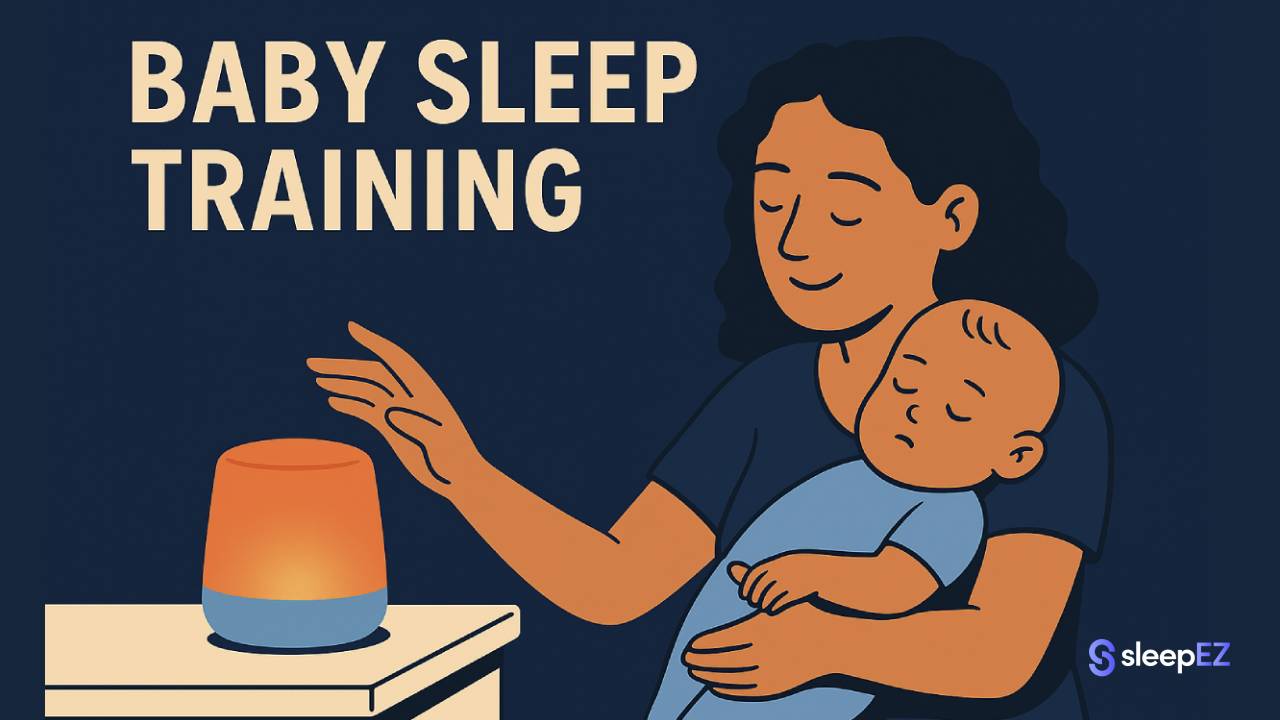
If you're reading this on your phone at 3 AM while rocking your baby for the third time tonight, you're not alone. You're tired. You're overwhelmed.
And you're probably wondering if there's a better way.
Sleep training is the process of helping your baby learn to fall asleep independently and self-soothe back to sleep when they wake during the night. It's not about leaving your baby to cry endlessly or abandoning them when they need you.
It's about teaching your little one a valuable life skill.
Think of it like learning to walk. At first, you hold their hands and guide them.
Then you let go and let them find their balance. Sleep training works the same way with sleep.
Here's what you'll learn: why sleep training benefits the whole family, when to start, how to create the perfect sleep environment, what methods work best, and the exact steps to take on your first night. You're about to give your baby (and yourself) the gift of independent sleep.
Quick Answer: What Is Baby Sleep Training?
Baby sleep training refers to methods that help babies learn to fall asleep independently and stay asleep through the night. Most approaches involve teaching babies to self-soothe, to fall back asleep on their own when they wake between sleep cycles.
The key facts:
- Most sleep consultants recommend starting between 4–6 months
- No single method works for every family, the best method is the one you can follow consistently
- A consistent bedtime routine and sleep environment are the foundation of any approach
- Most methods show results within 5–14 nights
What Age Should You Start Sleep Training?
| Age | Recommendation |
|---|---|
| 0–3 months | Too early, newborns have biological needs that require responsive feeding |
| 4–6 months | Ideal starting point for most methods, babies can begin learning to self-soothe |
| 6–12 months | Excellent candidate, most methods work well at this age |
| 12–18 months | Still possible, though some methods require adaptation |
| 18 months+ | Can be more challenging due to increased awareness, but still achievable |
The 4–6 month window is widely recommended because babies at this age have developed enough neurologically to begin self-soothing, while still being young enough that habits haven't become deeply entrenched.
Signs Your Baby Is Ready for Sleep Training
- ✅ Your baby can sleep for longer stretches (3–4+ hours) at night
- ✅ Your baby shows signs of being able to self-soothe (sucking fingers, settling briefly)
- ✅ Feeding schedule is becoming more predictable
- ✅ Nap times are becoming more regular
- ✅ Your baby is gaining weight appropriately
- ✅ Your baby is generally healthy with no current illness
When NOT to Sleep Train
Timing matters. Avoid starting sleep training during:
- Illness, a sick baby needs extra comfort and responsive care
- Teething, pain disrupts sleep independently of training
- Travel or major schedule changes, consistency is essential for success
- Sleep regressions, the 4-month, 8-month, and 12-month regressions are not ideal starting points
- Major life changes, moving house, starting childcare, or a new sibling
- Growth spurts, increased feeding needs make training counterproductive
- Parental stress or illness, sleep training requires consistent follow-through
If any of these apply, wait until the situation stabilises before beginning.
Why Consider Sleep Training? The Benefits for Baby & Parents
Sleep training isn't just about getting more rest (though that's pretty great too). It's about setting everyone up for success with better sleep quality and consistency.
For Your Baby:
- Better quality, more restorative sleep for crucial brain development
- Improved mood and less fussiness during the day
- Stronger immune system from adequate rest
- Better eating patterns and growth
- Learning the valuable skill of self-soothing
For You and Your Partner:
- More predictable evenings and return of personal time
- Improved mental health and reduced stress
- Better parent-child relationship when you're well-rested
- Restored energy to be the parent you want to be
- Better focus at work and in daily activities
As pediatrician Dr. Marc Weissbluth notes, well-rested children don't just have happier moods; they also show improved attention and learning. Research published in the National Center for Biotechnology Information confirms that sleep training improves infant sleep problems with no adverse effects reported after 5 years.
When your baby sleeps well through independent sleep skills, everyone thrives.
Sleep Training Methods Compared
| Method | Crying Level | Speed | Best Age | Best For |
|---|---|---|---|---|
| Cry It Out (CIO) | High | Fast (3–7 nights) | 6 months+ | Families who can commit fully |
| Ferber Method | Medium | Fast (5–7 nights) | 5 months+ | Families wanting structured check-ins |
| Chair Method | Low | Moderate (2–3 weeks) | 6 months+ | Families wanting gradual withdrawal |
| Pick Up Put Down | Low | Slow (3–4 weeks) | 4–6 months | Younger babies, responsive families |
| Fading Method | Very Low | Slow (3–4 weeks) | Any age | Families wanting the gentlest approach |
Method 2: Ferber Method (Graduated Extinction)
How it works: You put your baby down drowsy but awake, then leave the room. If they cry, you wait a set interval before going in to briefly reassure them, without picking them up. The intervals increase progressively over several nights.
Typical interval schedule:
| Night | First Wait | Second Wait | Third Wait+ |
|---|---|---|---|
| 1 | 3 minutes | 5 minutes | 10 minutes |
| 2 | 5 minutes | 10 minutes | 12 minutes |
| 3 | 10 minutes | 12 minutes | 15 minutes |
| 4+ | Gradually increase |
Best age: 5 months and older
Pros:
- Structured and predictable for parents
- Faster than gentler methods
- Check-ins provide reassurance for parents
- Well-researched with decades of evidence
Cons:
- Some crying is involved
- Check-ins can sometimes increase crying if they re-stimulate the baby
- Requires consistent follow-through
Best for: Families who want a structured approach with parental involvement, and who can commit to the intervals consistently.
Typical timeline: Most families see significant improvement within 5–7 nights.
Sleep Training Success Checklist
Before you begin, confirm:
- ☐ Baby is within the appropriate age range (4–6+ months)
- ☐ Baby is healthy with no current illness
- ☐ No major schedule changes planned for the next 2 weeks
- ☐ Room is dark, blackout curtains or sleep mask for parents
- ☐ White noise machine is set up and running
- ☐ Room temperature is 18–20°C
- ☐ Both caregivers agree on the method and can follow it consistently
- ☐ You've chosen a method you can commit to for at least 5–7 nights
- ☐ You have a plan for what to do if baby vomits or becomes unwell
The Foundation: Creating the Perfect Sleep Environment
No sleep training method works well without the right environment. This is where SleepEZ's products fit naturally into the process.
Darkness: Your baby's room should be completely dark during sleep. Even small amounts of light can suppress melatonin and signal "daytime" to your baby's developing circadian system.
Blackout curtains that seal around the edges are essential.
White noise: This is one of the most powerful tools for baby sleep training. White noise:
- Masks sudden household sounds that trigger the startle reflex
- Creates a consistent sleep environment that helps babies link sleep cycles
- Mimics the womb environment that babies find naturally calming
The Hush Sound Machine offers multiple sound options, adjustable volume, and a compact design that's easy to position safely in a nursery. Keep volume below 50 dB at crib level, see our guide on how loud is too loud for a baby sound machine.
Temperature: Keep the nursery between 18–20°C. Overheating is a risk factor for infant sleep safety.
Consistency: The environment should be the same for every sleep, naps and nights. Consistency is what makes the training work.
When is the Right Time to Start Sleep Training?
Most babies are ready for sleep training between 4-6 months old. This is when their sleep cycles start to mature and they rely less on frequent night feeds.
The American Academy of Sleep Medicine recommends that infants 4-12 months should sleep 12-16 hours per 24 hours for optimal health.
Signs Your Baby is Ready:
- Can go 4-5 hours between feeds consistently
- Has good weight gain and growth
- Can go longer stretches at night without feeding
- Shows signs of self-soothing (like sucking on fingers)
- Has predictable wake windows during the day
- Shows clear tired signals (yawning, rubbing eyes)
Before you start any sleep training method, get the green light from your pediatrician. They know your baby's health history and can confirm if sleep training is right for your little one. Mayo Clinic experts emphasize that helping your baby sleep independently is beneficial for the whole family.
The Foundation of Success: Creating the Perfect Sleep Sanctuary
Before you try any sleep training method, you need to set up the right environment. This isn't optional. It's the foundation that makes every method more successful.
A Consistent Bedtime Routine
A predictable routine (bath, book, pajamas) is a powerful set of sleep cues that signals to your baby's brain it's time to wind down. This routine becomes a cornerstone for teaching independent sleep.
A Pitch-Black Room
Darkness tells your baby's brain it's time to sleep. Use blackout curtains or shades to block out stimulating light from streetlights and early morning sun.
A Cool, Comfortable Temperature
Keep the room between 68-70°F (20-21°C). Babies sleep better when they're slightly cool rather than warm.
The Ultimate Tool: A Consistent Soundscape
This is where most parents miss a crucial step. Your baby spent nine months in the womb hearing constant background noise. A sound machine masks disruptive household noises, mimics the womb environment, and serves as a powerful sleep cue for independent sleep.
Dr. Harvey Karp, pediatrician and sleep expert, explains that the womb environment is louder than a vacuum cleaner. Your baby actually finds comfort in consistent sound for self-soothing.
This consistent sound is so vital that we've detailed the science behind using a white noise machine for your baby in our complete guide.
A reliable, multi-sound device like the Hush Sound Machine is perfect for this, as it offers both white and pink noise to create a truly consistent and soothing environment for any sleep training method.
Popular Sleep Training Methods
There's no single "right" way to sleep train. Choose the method that feels comfortable for your family and supports your baby's journey to fall asleep independently.
Cry It Out (CIO) / Extinction
You put your baby down awake and don't return until morning. This method focuses on complete independence from the start. It's often the fastest method but can be emotionally difficult for parents.
Pro-Tip: White noise can help mask household sounds that might wake your baby during the night, making this method more effective.
The Ferber Method (Graduated Extinction/Check-and-Console)
You check on your baby at timed intervals (3 minutes, then 5, then 10). You offer comfort with your voice but don't pick them up. This method gradually builds self-soothing skills.
Pro-Tip: Consistent background noise helps your baby stay calm between check-ins and prevents sudden household sounds from disrupting their progress.
The Fading Method (Chair Method)
You start by sitting next to the crib, then gradually move your chair farther away each night until you're outside the room. This method slowly reduces parental presence while maintaining consistency.
Pro-Tip: Keep the same background sounds playing throughout this process so your baby has one consistent comfort cue as other elements change.
Pick-Up, Put-Down Method
When baby cries, you pick them up until they calm down, then put them back in the crib awake. Repeat as needed. This method offers more hands-on comfort during the learning process.
Pro-Tip: Maintain steady background noise during this method to help your baby stay calm and focused on self-soothing rather than external distractions.
Your First Night: A Simple Step-by-Step Checklist
- Start your consistent bedtime routine (bath, feeding, story, pajamas)
- Dim the lights 30 minutes before bedtime to signal sleep time
- Activate your sound machine to white or pink noise at a safe volume and distance
- Put baby down awake but drowsy in their crib
- Leave the room calmly and confidently
- Follow your chosen method consistently without switching approaches
- Stay committed even if it feels hard - consistency is key
Remember: consistency in your bedtime routine, environment, and response is everything. Stick with your plan for at least 3-5 nights before making changes.
How Daylight Savings Affects Baby Sleep
Daylight savings time changes can disrupt a carefully established sleep training routine. Here's how to manage it:
When clocks go forward (spring): Your baby will effectively be put to bed an hour later. In the week before, gradually shift bedtime 10–15 minutes earlier each night.
When clocks go back (autumn): Your baby may wake an hour earlier. In the week before, gradually shift bedtime 10–15 minutes later each night.
The key: Don't make the full adjustment in one night. Gradual shifts of 10–15 minutes over 5–7 days are much easier for babies to adapt to.
Pros and Cons of Sleep Training
| Pros | Cons |
|---|---|
| Better sleep quality for the whole family | Can be emotionally difficult for parents initially |
| Baby learns valuable self-soothing skills | Some crying is inevitable during the learning process |
| More predictable bedtime routine | Not suitable for all families or situations |
| Reduced parental stress and improved mental health | Requires consistency and commitment from parents |
| Creates foundation for lifelong healthy sleep habits | May take several nights to see full results |
As Dr. Craig Canapari of Yale University assures parents, "Sleep training your child is not selfish, and sleep training doesn't hurt your child." Long-term studies published by the American Academy of Pediatrics found no harmful effects on children's behavior, sleep, or parent-child relationships after sleep training.
Frequently Asked Questions
What age is too early to sleep train?
Most sleep consultants recommend waiting until at least 4 months. Before this age, babies have genuine biological needs that require responsive feeding and comfort, sleep training is not appropriate.
Can you sleep train a 4-month-old?
Gentle methods like Pick Up Put Down or the Fading Method can be introduced around 4 months. More structured methods like Ferber or Cry It Out are generally better suited to 5–6 months and older.
Can you sleep train a newborn?
No. Newborns (0–3 months) need responsive care and frequent feeding. Sleep training is not appropriate at this age.
What is the gentlest sleep training method?
The Fading Method is generally considered the gentlest, as it involves gradually reducing parental presence without any planned crying. The Chair Method is also gentle and involves staying in the room.
Which sleep training method works fastest?
Cry It Out (extinction) and the Ferber Method typically show results within 3–7 nights. Gentler methods like the Chair Method may take 2–3 weeks.
Is sleep training harmful?
Multiple long-term studies have found no evidence that sleep training causes psychological harm to babies. Research consistently shows that sleep-trained babies and their parents have better sleep outcomes without negative developmental effects.
How many nights does sleep training take?
Most families see significant improvement within 5–14 nights, depending on the method and consistency of implementation.
Can I use white noise during sleep training?
Yes, white noise is highly recommended during sleep training. It masks household sounds that can disrupt the process and creates a consistent sleep cue.
Can teething ruin sleep training?
Teething can temporarily disrupt established sleep patterns. If your baby is actively teething with significant discomfort, it's better to pause training and resume when the pain subsides.
What if my baby vomits while crying?
Go in, calmly and quietly clean up with minimal interaction, then return to your chosen method. Vomiting from crying is unpleasant but not dangerous. Staying calm and consistent is important.
How long does sleep training usually take?
Most babies show improvement within 3-5 nights when parents maintain consistency. Complete success with independent sleep typically happens within 1-2 weeks.
Every baby learns self-soothing at their own pace.
Is it okay for my baby to cry during sleep training?
Yes, some crying is normal and expected during any sleep training method. You're not hurting your baby - you're teaching them how to self-soothe and fall asleep independently.
Set a timer if it helps you stay committed to your chosen approach.
Will sleep training hurt my bond with my baby?
No. Research shows that sleep training doesn't damage the parent-child relationship. A well-rested parent is actually more emotionally available and responsive during awake hours.
Your bedtime routine and consistent response build trust. Studies from NPR's analysis of sleep training research concluded there were no harmful effects on children's behavior, sleep, or parent-child relationships.
What if sleep training isn't working for us?
If you don't see any improvement after a full week of consistency, take a break and try again in 2-3 weeks. Your baby might not be developmentally ready yet.
Make sure your bedtime routine and sleep environment are optimized before trying again.
What is the 5-3-3 rule for sleep training?
The 5-3-3 rule suggests putting your baby to bed 5 hours after their last nap, ensuring they stay awake for 3 hours before bedtime, and keeping bedtime within a 3-hour window each night. This creates consistency that supports self-soothing skills.
What is the 3-minute rule for sleep training?
The 3-minute rule refers to waiting 3 minutes before responding to crying during certain sleep training methods like Ferber. This gives your baby time to practice self-soothing and fall asleep independently before you intervene.
Consistency, Patience, and Restful Nights Ahead
Sleep training is one of the best gifts you can give your family. You're not being selfish by wanting better sleep. You're being a smart parent who understands that teaching independent sleep skills benefits everyone's health and happiness.
Consistency in your bedtime routine, sleep environment, and chosen method is your secret weapon. Pick an approach that feels right, set up the perfect sleep sanctuary, and stick with your plan. Your baby is capable of learning to self-soothe and fall asleep independently.
Those peaceful nights you're dreaming of? They're closer than you think. You've got this, and soon you'll both be sleeping soundly through the night.

Leave a comment
This site is protected by hCaptcha and the hCaptcha Privacy Policy and Terms of Service apply.